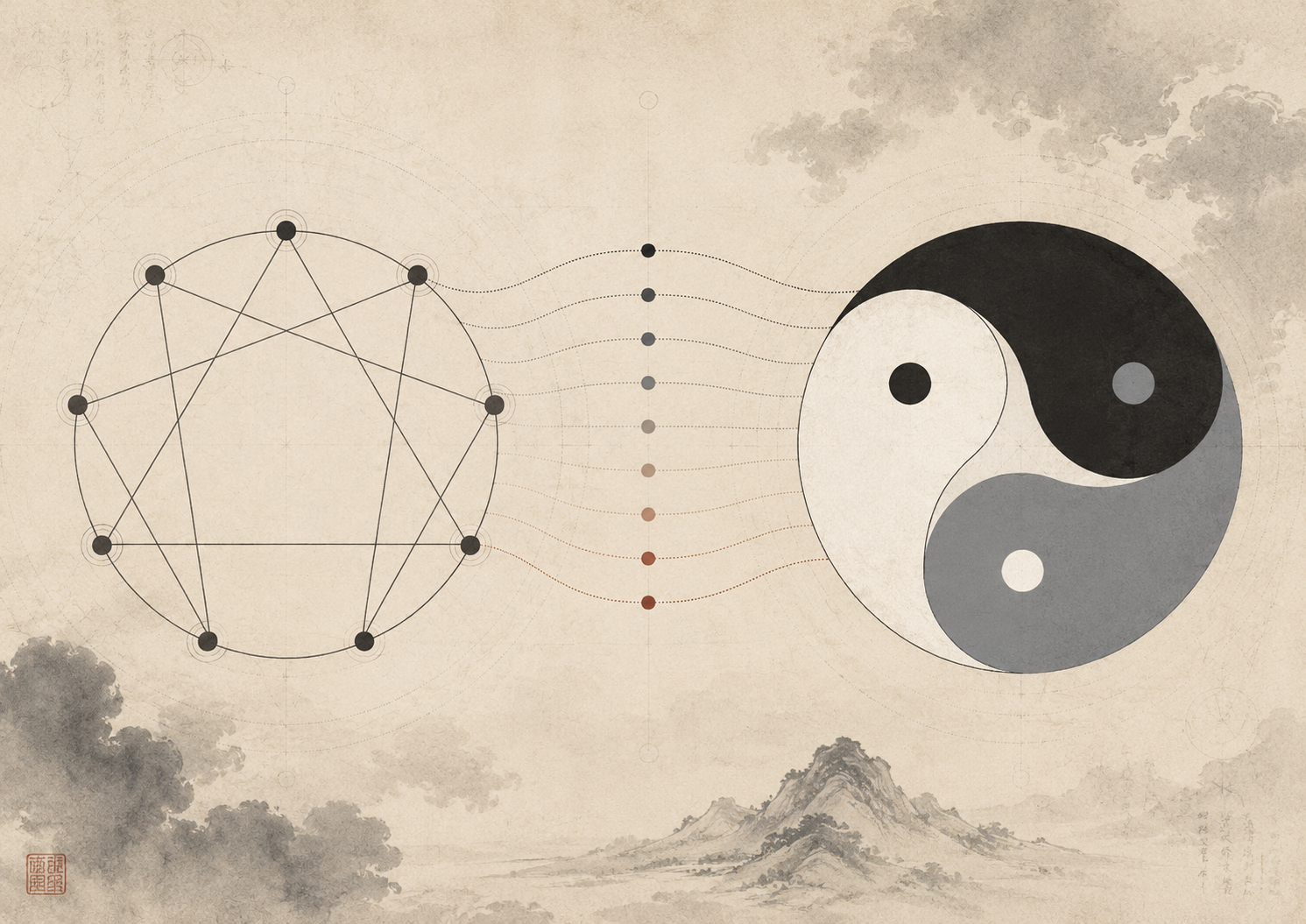
Here is a question that is easy to ask and, as far as I can tell, has never actually been asked: does the content of Enneagram Type One look anything like the content of the Taixuanjing‘s first quarter? Type Six like the sixth? And so on down the line.
You have to lift both sets of material out of their native contexts to do it. A personality type is not a divinatory station, an ego-fixation is not a phase of qi, and I’m going to assume you already know that rather than spend three sections proving it. The question isn’t whether the two systems are the same kind of object. They obviously aren’t. The question is whether, when you set the content side by side, anything rhymes.
Something does. Four of the nine match strongly, a fifth is respectable, and — more interesting than either — the places where it fails are not random.
The setup
The Taixuanjing 太玄經, Yang Xiong’s Canon of Supreme Mystery, was written around 2 BCE as a ternary rival to the Yijing: three line states instead of two, four positions instead of six, 81 tetragrams instead of 64 hexagrams. Those 81 nest into nine groups of nine, defined by the first two lines — Yang Xiong’s own architecture, not an editorial convenience. I’ve given the nine groups English names in the course of another project: Hidden, Unstraight, Peopled, Strong, Bright, Measured, Shutting, Dark, Cold.
The Enneagram’s nine types need no introduction. I’m using them at the level of their standard concerns — what each type is preoccupied with, defends against, and pursues — rather than any one lineage’s descriptions.
Now the walk.
One · Hidden
Stronger than I expected, and the figure names do most of the work. Three of the nine tetragrams in this quarter are Barrier (閑 — restraint, a guarded limit), Perversity (戾 — contrary, crooked, wrong), and Trespass (干 — offense against a boundary). Rule, fault, violation: the One’s entire preoccupation, in three consecutive names.
The quarter’s governing image seals it. A strong force is present underground and cannot yet act — it is mired, it is barred by the yin, it drills at what is hard until the sound comes through. And Coming, which closes the quarter, is glossed as strong within and weak without. That is the One’s structure exactly: the force is inside, the presentation is restraint.
Strong.
Two · Unstraight
Excess (羨, which carries both surplus and covet), Increase, Interaction (交, exchange), Yielding (soft and pliant — “seeing difficulty, it draws back”), and Waiting, glossed as waiting on something outside itself before it will advance.
Giving, softness, exchange, and dependency on another’s response, in five of nine figures. Not as tight as One, but not luck either.
Good.
Three · Peopled
This one barely needs arguing. Progress. Conflict (爭 — to contend, to compete). Endeavour (務 — to strive at a task). Affairs (事 — office, business). The quarter’s texts have things standing on tiptoe to follow, coming out in throngs, each office made plain, each thing spending its own strength.
Work, competition, visibility, role. If you handed this quarter to someone who knew the types and asked them to guess, they would guess Three.
Strong.
Four · Strong
Nothing here. The quarter is force and abundance: hard without and strong within, able to cut and decide, closing in pure hardness with nothing that is not a strong beam. The Four is lack and longing.
The only thread is Packing, where a faint yin takes the ground below while the work is at its height — something missing at the peak. That’s a reach, and I’d rather report a miss than manufacture a match.
Miss.
Five · Bright
Splits, and the split is instructive.
The epistemic content matches well. Purity — even and unmixed, clear and bright. Law — the marking-line, from which nothing escapes. The Answer. Clarity, system, comprehension, non-contamination: all Five.
The energetic valence is the opposite. This quarter is maximal expansion and visibility — the year’s noon, the summer solstice, everything shown. The Five contracts and conceals.
Split. Hold that thought.
Six · Measured
The strongest on the board.
Rites — upper and lower each in their own body. Constancy — minister and lord each knowing which they are, so that nothing changes in ten thousand ages. Then Measure, Enduring, and Togetherness, which “prizes sameness.”
Authority, hierarchy, tradition, loyalty, alliance, and group conformity — in five consecutive figures. And the quarter’s anxiety runs underneath all of it: Retreat, where things are about to be lost, and Vastness, swept wide and empty. That is the Six’s ground going away.
Strong.
Seven · Shutting
Inverted, and this is the finding.
The quarter is Decrease, Withholding (nothing will transform, nothing will pour out, every one of the ten thousand things shuts its mouth), Guarding (nothing gets at anything else), Accumulation (everything about to shut, one small opening kept, mountain and marsh becoming where things are stored), and Looking.
Contraction, hoarding, privacy, observation. That is not the Seven in any respect. It is the Five, item by item — including avarice-as-withholding, which is the Five’s passion under its own name.
Inverted.
Eight · Dark
Weak but not empty. Hardness, where things compete at being hard, and Cutting are recognizably Eight. The rest of the quarter is loss, dimming, and exhaustion, which isn’t.
Weak.
Nine · Cold
Compliance 順: the yin breath goes along with everything; it is a mixed dark with no edge to it, and nobody sees where it is rooted.
Going along, edgelessness, and not knowing where one’s own position is — self-forgetting in a single line. Toil and Nourishing add the plodding endurance and the feeding of others that round the type out.
Strong.
The tally, and the anomaly
Four strong (One, Three, Six, Nine), one good (Two), one split (Five), one inverted (Seven), one weak (Eight), one miss (Four).
For context: if you shuffled nine descriptions against nine and matched at random, the expected number of correct pairings is exactly one — a pleasant fact that holds for any number, not just nine. Four solid hits is not what chance produces.
But the tally is not the interesting part. The two failures are adjacent in a specific way. Quarter five carries the Five’s epistemics. Quarter seven carries the Five’s behavior — withholding, guarding, storing, watching. The Seven’s content appears nowhere in the sequence at all.
So it isn’t that two stations happen to miss. It is that a single type appears to have been distributed across two stations, displacing the type that should have occupied the second one. And on the Enneagram’s own hexad, Five and Seven are joined by an arrow.
I don’t know what to make of that. It could be a real structural fact about how these two systems partition the same territory. It could be an artifact of how I named the quarters, since I named them before I ever thought of the Enneagram and my names are doing real work in this comparison. Either way it’s a locatable, specific anomaly rather than a vague resonance, and specific anomalies are where the next piece of work lives.
The structural picture, briefly
I spent a while on the architecture before getting to the content, and while the content is the more useful finding, a few structural notes are worth keeping.
Both systems are ternary revolts against a binary. Yang Xiong’s three line states encode heaven, earth and man — his argument against the Yijing is that two terms leave out the human position standing between. Gurdjieff’s Law of Three is the same objection to dualistic thinking. Two systems, two millennia apart, both built as arguments that three is the minimum number of terms the world requires.
Both are built on a remainder. The Law of Seven rests on intervals where a process will deviate unless something enters from outside; one-seventh never resolves. Yang Xiong’s 81 figures at four and a half days give 364.5, short of the solar year, so two appraisals stand outside the count of 729 and are what close it. Both systems refuse to round the discrepancy away and instead give it the job of closing the cycle. The Taixuanjing‘s eighty-first figure is Nourishing, and what it nourishes is the first.
And a correction to something I got wrong along the way: I had said the types aren’t ordered, which is false — Ichazo’s descent from the Holy Ideas into the fixations is emanationist, the hexad is a sequence, and the centers group the nine into triads. The accurate statement is that the order runs on a different axis. Emanation is derivation, not passage: nine parallel vertical descents, one per type, rather than one lateral sequence. Nobody proceeds from the fourth fixation to the fifth. The quarters are lateral and temporal, forty and a half days apiece.
One more, which surprised me: neither system ranks its nine. The Enneagram holds that no type outranks another. And the Taixuanjing does not hold that summer outranks winter — its fortunes grade the fit between a position and its hour, not the worth of the stations. Both then run a graded vertical axis inside each of the nine: degrees of integration within a type on one side, nine appraisals within every figure on the other. Nine unranked positions, each with its own ladder. That structure is genuinely shared.
Two invitations
To Enneagram researchers. The Taixuanjing is worth your attention as a source at the intersection of type theory and divination — a place where nine-fold content of a recognizably similar kind is embedded in a working divinatory system rather than in a psychology. It is a two-thousand-year-old body of material about nine stations that nobody in the Enneagram world has read, and four of nine landing solidly is enough to justify the reading. At minimum it offers a natural experiment: what does nine-fold content look like when it develops with no reference to personality at all?
To students of the Taixuanjing. The reciprocal question is at least as interesting, and stranger. Is there any sense in which the tetragrams carry characterological information? The text is a calendar and an oracle, and nobody reads it as a typology — but the nine appraisal positions are already keyed to decades of a human life, so Yang Xiong was not indifferent to the shape of a person. Whether the nine provinces carry anything similar is an open question, and the Enneagram provides a ready-made grid against which to test it.
What would settle it
Give raters who have never heard of this comparison nine quarter summaries and nine type descriptions, shuffled, and ask them to match one-to-one. Four or more means something. One means I have been pattern-matching in public. I’d want that run before anyone builds anything on the Five/Seven displacement, however pretty it is.